AI Chatbot for Lead Generation on a Service Business Website: What the Data Says
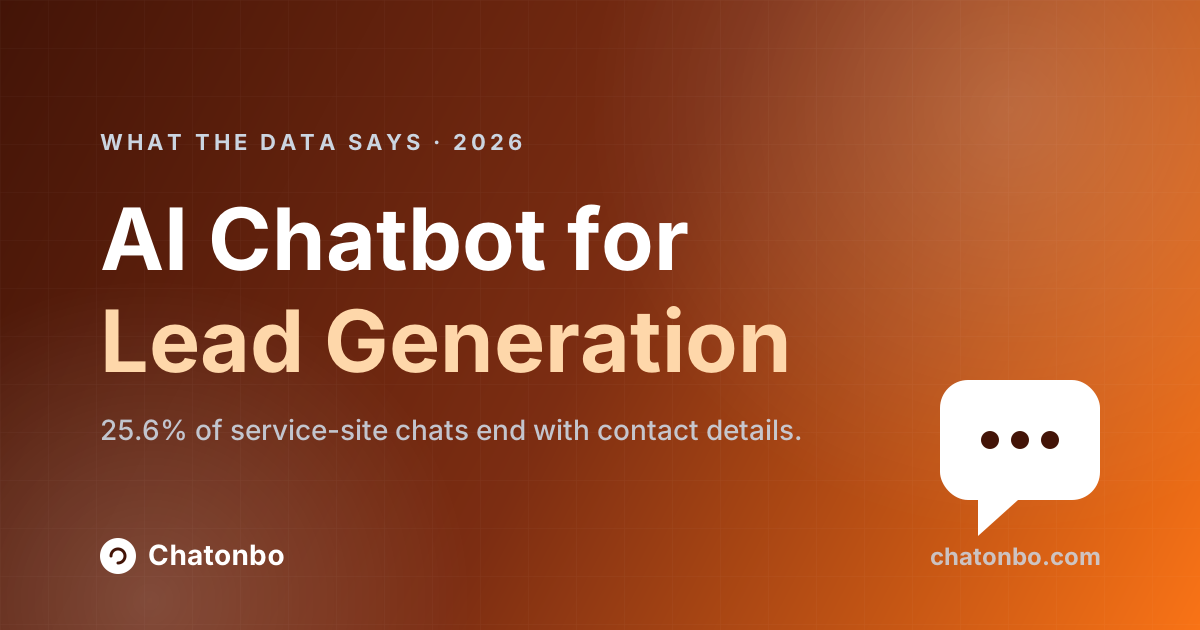
TL;DR: An AI chatbot generates leads on a service business website by answering the visitor's question first and asking for contact details at the moment they want a quote, a call or a demo. Service and B2B sites get the highest lead rates of any site type: across live Chatonbo assistants, 25.6% of conversations on service and lead-generation sites end with the visitor leaving a name, an email or a phone number, against 8.9% on online stores, and 47.7% of conversations that reach four visitor messages end with contact details. The assistant can also book meetings through your calendar link and sends every lead to your inbox, CRM or webhook with a summary.
Why do service websites get more leads from a chatbot than stores?
On a store the visitor can finish the job alone: find the product, add it to the cart, pay. On a service website the job is almost always a conversation: "do you handle cases like mine", "what would this cost", "can you do it by March". There is no cart. The natural end of a good answer is "leave your details and we will confirm", and visitors do exactly that.
The numbers from live assistants bear it out:
| Site type or situation | Share of conversations ending with contact details |
|---|---|
| Service and lead-generation sites | 25.6% |
| Online stores | 8.9% |
| All live website assistants | 12.8% |
| Conversations with four or more visitor messages | 47.7% |
| Conversations with a single visitor message | 3.8% |
Sources: Chatonbo help centre and the [AI chatbot statistics 2026](/research/ai-chatbot-statistics-2026) page, measured on live customer websites. The last two rows are the ones to design around: the lead comes from the fourth message, not the first, so an assistant that keeps a useful conversation going outperforms any pop-up form.
How does an AI chatbot capture a lead?
Not with a gate. Assistants that demand an email before answering get the 3.8% rate of a one-message conversation. The approach that produces the 25.6% rate looks like this:
- Answer from your pages. The visitor asks about a service, a price range, an area you cover or a timeline. The assistant answers from your website content.
- Ask at the right moment. When the visitor wants something the site cannot give, a quote, a call, availability, a specific case, the assistant asks for a name and an email or phone number, with the reason.
- Recognise the details in the conversation. No form. The visitor types "it's [email protected]" and the lead is captured, with the whole conversation attached.
- Offer a time. If you connect a booking page, the assistant opens it inside the chat for Calendly and cal.com, or links to it for any other booking tool, so a visitor who wants a call books it there and then.
- Deliver the lead. Email, Zendesk, Zoho, HubSpot, Slack or any webhook, with a summary of what the visitor wanted and where they came from (search, ad campaign, referral).
When a visitor comes back later and leaves the same details again, the assistant does not create a duplicate; you get a "visitor came back" note on the existing lead instead.
What questions do service-site visitors ask?
Product questions are the largest category on every kind of site, about a third of all conversations, and on service sites "product" means the service itself: scope, eligibility, process and price. Pricing is around one in ten conversations. Only 1.0% of conversations ask to be handed to a human, which surprises most owners; visitors are happy to talk to an assistant as long as the answer is specific to your business.
Timing matters as much as content. 39% of website chats start outside 9:00 to 18:00 in the visitor's local time, 20.7% in the evening and 18.3% at night. For a service business that means a large share of enquiries arrive when nobody is answering the phone, and an assistant that captures the lead at 22:00 is the difference between a booked call and a visitor who tried a competitor the next morning.
What results have service businesses published?
- [OMC](/customers/omc), a B2B company, reports 40% more leads from its website, with 30% of support tickets resolved by the assistant.
- [Agura](/customers/agura) generated 25% more leads in its first month, from visitors who would never have filled in a contact form.
- [Kamatera](/customers/kamatera), a cloud provider, converts 34% more visitors into billable trial signups, because technical evaluators get their answer in the same session.
- [JetServer](/customers/jetserver) grew online hosting purchases by 44% with the assistant guiding buyers to the right plan.
Each page carries the customer's own numbers and the context behind them.
How do you set it up on a service website?
- Enter your website URL. Chatonbo drafts the assistant from your pages in about two minutes.
- Add anything the site does not say: a price list, service areas, FAQs, a PDF brochure. The assistant uses it immediately.
- Connect your booking page and your lead destination (email, CRM or webhook). The [lead generation assistant page](/solutions/lead-generation-agent) shows the options.
- Install the one-line script, or the plugin on WordPress, Wix or Squarespace, or ask us to [install it for you](/install-for-me).
- Watch the "questions your assistant could not answer" list for the first week and add the answers. Each answer raises the share of conversations that reach the fourth message.
Pricing is flat: free to start, Pro $19 a month for 5,000 conversations, Business $59 a month for 10,000, with CRM integrations from Pro up and unlimited team members on Business. See [pricing](/pricing).
What does a conversation that ends in a lead look like?
A visitor lands on a tax advisory website at 21:40 and opens the chat:
- Visitor: "Do you handle VAT registration for a company based abroad?"
- Assistant: "Yes. We register foreign companies for VAT and handle the quarterly filings. The process takes about three weeks once we have the company documents. Are you registering a new company or an existing one?"
- Visitor: "Existing, in Germany. What does it cost?"
- Assistant: "Registration is a fixed fee and the quarterly filings are priced by volume; the exact quote depends on your transaction count. If you leave your name and email, an advisor will send the quote tomorrow morning. You can also pick a call time here." (booking page opens in the chat)
- Visitor: "Sure. Dan Weber, [email protected]"
The lead arrives with the summary: existing German company, VAT registration plus filings, asked about cost, booked no call. The adviser's email the next morning is specific instead of "thanks for your enquiry". The visitor got an answer at 21:40, which the contact form would have given at 09:30 the next day, if at all.
How do you measure lead generation from a chatbot?
Three figures, all in the dashboard:
- Lead rate: conversations ending with contact details divided by all conversations. The benchmark across live assistants is 12.8%; service sites sit above it, at 25.6%.
- Depth: the share of conversations that reach four visitor messages. Every answer you add to the knowledge base pushes this up, and the lead rate follows it.
- Leads outside business hours: the share of leads that arrived when nobody was answering the phone. This is the number that justifies the assistant on its own.
Attribution is attached to each lead, so you can also see which ad campaign, search query or referral produced the visitor who chatted.
See what your visitors would ask
Enter your website and read the drafted assistant's answers before you install anything. [Try it on my site](/try-it).
FAQ
Does an AI chatbot work for lead generation on a service website?
Yes, and service sites are where it works best. Across live Chatonbo assistants, 25.6% of conversations on service and lead-generation sites end with the visitor leaving a name, an email or a phone number, against 8.9% on online stores.
How does a chatbot capture a lead without a form?
It answers the visitor's question first, then asks for contact details when the visitor wants a quote, a call, a demo or an answer the site does not have. The details are recognised in the conversation and sent to your inbox, CRM or webhook with a summary.
What share of chatbot conversations become leads?
About 12.8% across all live website assistants, 25.6% on service and lead-generation sites, and 47.7% of conversations that reach four or more visitor messages. Keeping the visitor talking matters more than the form.
Can the chatbot book meetings?
Yes. Chatonbo opens your booking page inside the chat for Calendly and cal.com and links to any other booking page, so a visitor who wants a call picks a time without leaving the conversation.
Where do the leads go?
To your email, to Zendesk, Zoho, HubSpot or Slack, or to any webhook, each with the conversation summary and the ad or search source the visitor came from.
Written by
Amit ZenoFounder & CEO · Chatonbo
Founder of Chatonbo. Building the AI chatbot platform small businesses actually use.
See it work on your own website
Paste your URL and chat with an AI agent trained on your content - right now, in 60 seconds.
Try It on Your Website