
Chat-to-Lead Conversion Rate Benchmark 2026: 12.8% of Conversations End With Contact Details
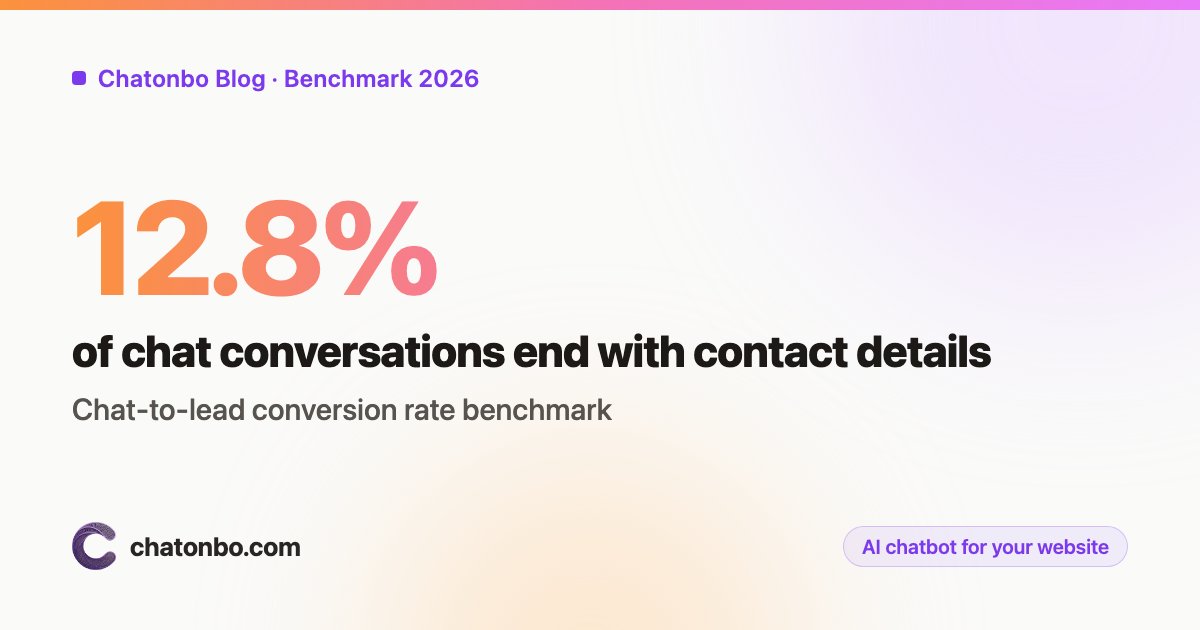
TL;DR: In Chatonbo's analysis of 5,470 real website chat conversations from 246 AI assistants, 12.8% ended with the visitor leaving an email address or phone number. The rate was 18.3% on general business websites (services, agencies, local businesses) and 9.1% on Shopify stores. If your assistant is below those numbers, the usual cause is asking too early or not at all, not a lack of interest: 8.8% of all conversations were the visitor explicitly wanting to be contacted. The way to capture more without nagging is to answer first, then ask once, with a reason.
What is the benchmark?
We counted every conversation held on 246 live assistants between 13 June and 11 September 2026 and checked whether it ended with the visitor leaving contact details. The full method and every other figure are on the What shoppers ask an AI chat assistant study page.
| Metric | Value |
|---|---|
| Conversations ending with an email or phone number (all sites) | 12.8% |
| Same, general business and service websites | 18.3% |
| Same, Shopify stores | 9.1% |
| Conversations where the topic was "visitor wants to be contacted" | 8.8% |
| Opening messages asking for a human or contact details | 2.3% |
| Conversations that went beyond a single exchange | 46.3% |
Two ways to read the 12.8%. The pessimistic one: seven in eight conversations end without a lead. The realistic one: the denominator includes every "hi" and every one-line shipping question. 12.7% of opening messages were a greeting or a test, and 53.7% of conversations were one question and one answer. Many of those visitors got what they came for and had no reason to leave an email. A lead rate is not a satisfaction rate.
Why do service sites convert more chats than stores?
The gap between 18.3% and 9.1% is not a quality difference. It is a difference in what the visitor wants.
On a Shopify store, 46.9% of conversations are product questions. The shopper asks whether the jacket runs small, gets the answer, and goes back to the product page. Only 35.8% of Shopify conversations went past a single exchange. The conversion the merchant cares about happens at checkout, not in the chat transcript.
On a service or business site there is often no checkout. The natural next step after "do you handle commercial leases" is "can someone call me". 50.5% of conversations on general business sites were multi-turn, and the assistant has more room to earn the ask.
So benchmark yourself against the right number. A store at 9.1% is doing fine if sales are moving. An agency at 9.1% is leaving half its leads on the table.
How to capture contact details without nagging
The assistants at the top of the range share a pattern: they treat the email as something the visitor gets value from, not something the business extracts.
1. Answer first, always. The average opening message is 51 characters and only 35.7% contain a question mark. The visitor typed "price for 2 users" and wants a number. Any assistant that replies "Sure! What is your email?" before the number has just turned chat into a contact form.
2. Ask when there is a reason. The strongest asks are tied to something the visitor cannot get in the chat window:
- A quote or proposal ("want me to have the team send exact pricing for 12 seats?")
- A restock or back-in-stock alert
- An order update or a return label
- A human reply when the question needs one, especially after hours (39% of conversations in the study started outside 9:00 to 18:00 local time)
3. Ask once. If the visitor ignores or declines the request, the assistant should continue answering as if nothing happened. Repeating the ask is the single fastest way to a closed chat window.
4. Make it optional and say what happens next. "If you leave an email I will send the size chart and the team will confirm the delivery date, usually within a working day." Specific promise, specific benefit, no obligation.
5. Let the assistant recognise a lead when it appears. Visitors often volunteer an email in the middle of a sentence. The assistant should capture it, confirm it, and not ask again. On Chatonbo the detection is automatic and the lead is pushed to your inbox, CRM or webhook with the transcript and an AI summary; the lead capture page shows the flow.
6. Never gate the answer. Requiring an email before the assistant will reply converts a small number of very motivated visitors and loses everyone else. The 12.8% in the study came from assistants that answer for free.
What should you do with the lead once you have it?
A chat lead is different from a form submission. The person asked a real question, got a real answer, and then chose to leave contact details. Treat it accordingly:
- Reply with the transcript in front of you. Do not ask them to repeat what they told the assistant.
- Reply the same working day. The conversation was live; the interest decays fast.
- Tag the source. Chat leads that arrived from a specific product page or a pricing page tell you what the visitor was weighing.
The 12.8% lead rate and the other benchmarks in this post are kept current on AI chatbot statistics 2026.
How to measure your own chat-to-lead rate
Take a full month of conversations. Count the ones where the visitor left an email or phone number. Divide by the total, including the greetings and one-liners, so your number is comparable to the benchmark.
- Below 9.1% on a store or below 18.3% on a service site: check when the assistant asks. Usually it asks too early or never.
- Around the benchmark: work on the reason for the ask. Add a quote flow, a restock alert, or an after-hours follow-up.
- Well above it: check lead quality. A high rate with a lot of junk addresses usually means the assistant is asking on every turn.
If you are still choosing a platform, price the lead rate against the plan, not the seat count: a flat monthly fee with unlimited leads is on the pricing page, and you can test what your own visitors would ask on the live demo before you sign up.
One in eight conversations becomes a lead when the assistant answers well and asks once. That is the benchmark. Everything above it comes from the reason you give the visitor to say yes.
FAQ
What is a good chat-to-lead conversion rate for a website chatbot?
A 2026 benchmark from 5,470 real website chat conversations puts the average at 12.8% of conversations ending with the visitor leaving an email address or phone number. Assistants on general business and service websites converted 18.3% of conversations, while assistants on Shopify stores converted 9.1%.
Why do Shopify chatbots capture fewer leads than service websites?
Because shoppers want an answer, not a callback. In the same study 46.9% of Shopify conversations were product questions and only 35.8% went past a single exchange, against 50.5% on general business sites. On a store the conversion happens at checkout, so a lower lead rate is normal and not a failure.
How do you get chat visitors to leave their email without being pushy?
Answer the question first, then ask only when there is a concrete reason the visitor benefits from a follow-up: a quote, a restock alert, an order update, or a human reply after hours. Ask once, make it optional, explain what they get, and never block the answer behind the email field.
Written by
Sarah ChenHead of Growth · Chatonbo
Growth lead at Chatonbo. Writes about lead capture, conversion, and funnel design.
See it work on your own website
Paste your URL and chat with an AI agent trained on your content - right now, in 60 seconds.
Try It on Your Website