Do Website Visitors Want a Human Instead of a Chatbot? Only 1% Ask (2026 Data)
TL;DR: Across 5,470 real website conversations on 246 assistants, 1.0% asked to talk to a human. On live online stores it is 1.3% of messages, and complaints are 0.4%. Visitors are not rejecting the assistant. The real problem is smaller and more fixable: what happened to that 1%. Before September 19, 2026, 40% of human requests and 60% of complaints on Chatonbo assistants ended in a dead end, with no contact taken and no merchant told. That is the failure to design against, not the imaginary revolt.
The myth and the number
Every second article about AI chat leads with a survey in which most people say they would rather talk to a person. Surveys measure what people say. Conversations measure what they do. In 90 days of real website chats:
- 1.0% of conversations asked for a human
- 46.3% went past a single question
- 28% reached a third visitor message
- 12.8% ended with the visitor leaving a name, an email or a phone number
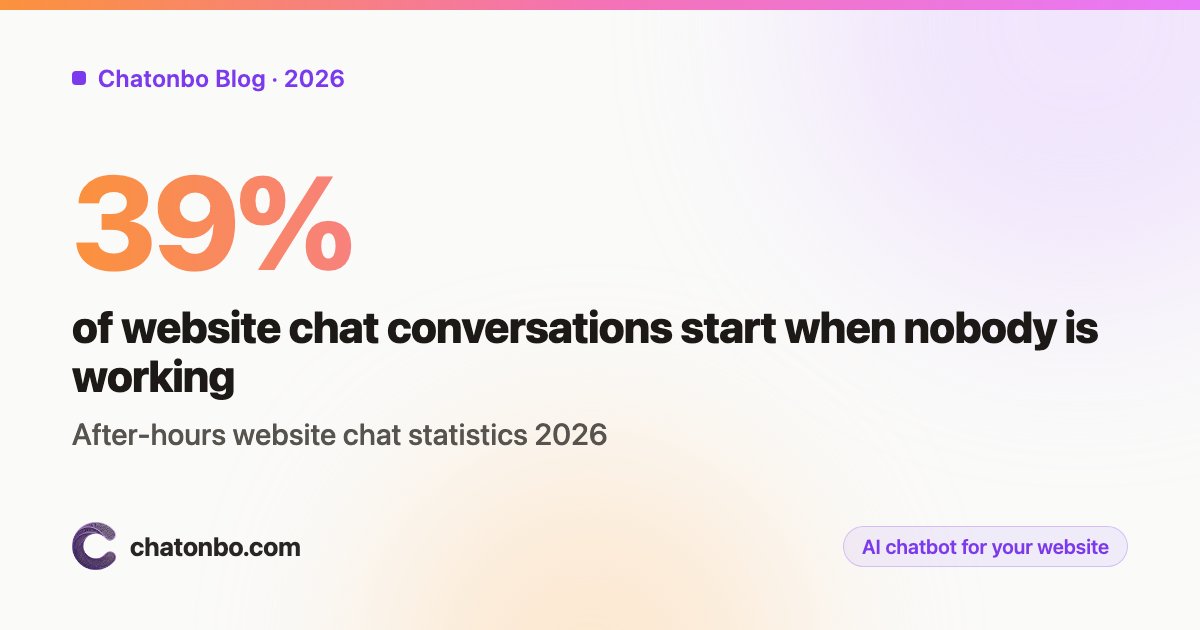
- 39% started outside 9:00 to 18:00 local time, when there was no human to ask for anyway
On storefronts specifically, 1.3% of messages asked for a person and 0.4% were complaints. The wider figures are in the full study, and the current set of numbers is on AI chatbot statistics 2026.
Where the real damage was
We looked at what the assistant did with those requests. It was not good. In the 60 days before September 19, 2026:
- 40% of "talk to a human" requests ended without contact details taken and without a next step
- 60% of complaints ended the same way
- these were the conversations with the most thumbs-down of any intent, at 5%
The visitor who asks for a person is the visitor with the most at stake: a damaged order, a billing problem, a refund. Losing them is not a 1% problem. It is the most expensive 1% on the site.
The rule we now enforce
Every Chatonbo assistant follows one rule for this case, and it overrides the merchant's own instructions on pacing: when the visitor asks for a human, wants to complain, or has a problem the assistant cannot fix, it does all of this in one reply.
- Acknowledge the problem in one sentence.
- Give the business contact details it has (email, phone, hours). If it has none, it skips them rather than saying so.
- Ask for the visitor's email or phone plus a one-line description.
- Say the team will get back to them, without inventing a time.
And on the merchant side: one alert per conversation, a couple of minutes later so it carries the email the visitor just gave, by email, webhook or Slack, with the last messages attached, plus a "needs a human" view in the dashboard. Capped at ten alerts an hour per store, so a script cannot turn it into a mail bomb.
What this means for a store owner
- Do not build your chat strategy around the fear of the 1%. Build it around the 99% who ask about products, prices, shipping and orders.
- Do design the 1% path carefully, because it is where refunds, chargebacks and one-star reviews start.
- Measure it. If you cannot see how many human requests dead-ended last week, you do not know your worst number.
FAQ
What percentage of visitors ask a chatbot for a human?
1.0% of conversations in a 90-day analysis of 5,470 website chats across 246 assistants, and 1.3% of messages in a 60-day sample of 9,480 messages on live online stores. Complaints were 0.4% of storefront messages.
Do people hate talking to chatbots?
The behaviour says no: 46.3% of conversations go past one question, 28% reach a third visitor message, and 12.8% end with the visitor leaving contact details. Visitors who want a person say so, and they are about one in a hundred.
What should happen when a visitor asks for a human?
The assistant should never end the conversation with "I cannot help with that". It should acknowledge the problem, give the business contact details it has, take the visitor's email or phone plus a one-line description, promise a follow-up, and the merchant should be alerted once with the transcript. In the data, 40% of human requests and 60% of complaints used to dead-end before that rule existed.
Written by
Elena KowalskiHead of Customer Success · Chatonbo
Customer Success lead. Turns chatbot deployments into measurable business outcomes.
See it work on your own website
Paste your URL and chat with an AI agent trained on your content - right now, in 60 seconds.
Try It on Your Website