From Website Visitors to Customers: How AI Can Improve Your Conversion Rate
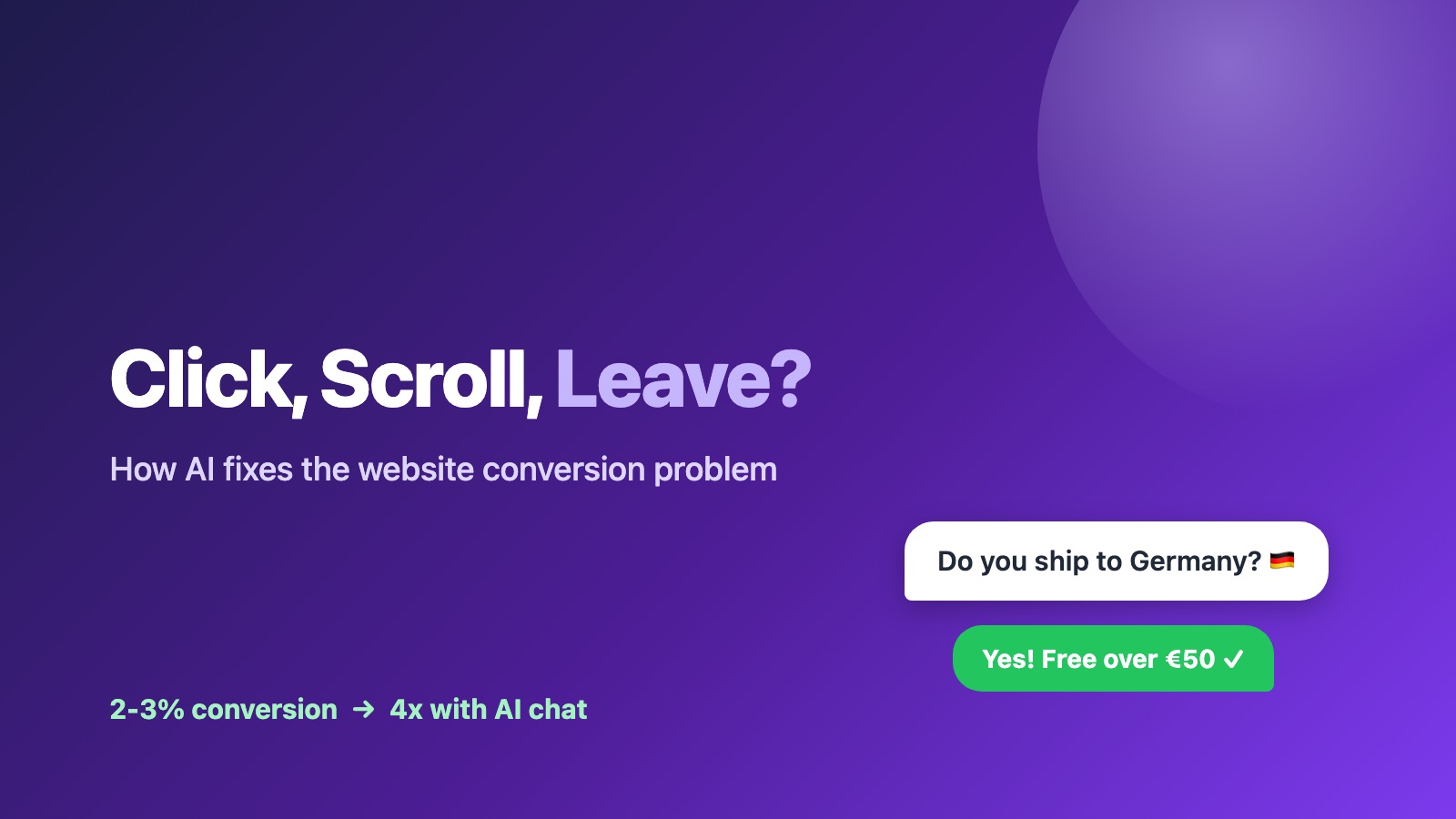
TL;DR: Most websites lose visitors not because of bad design, but because they stay silent when visitors need answers. Adding AI, such as an AI chatbot or a smart AI agent, gives your site the ability to respond, guide, and convert visitors in real time, with data suggesting conversion rates can increase by 20-35% or more.
Getting people to your website is one thing. Getting them to stay, trust you, and take action is a completely different challenge. You can pour time into how to make a website that looks sharp, loads fast, and says all the right things, and still watch most of your visitors leave without doing anything.
Wix offers a fast and intuitive website builder to bring your vision to life in minutes. But building a great website is only the first step. The real challenge begins once visitors arrive. Even with modern web design, the average website converts only around 2-3%, highlighting the gap between attracting visitors and turning them into customers.
AI changes that equation. Not by replacing your website, but by giving it a voice.
Why Most Websites Lose Visitors Before They Ever Connect
Think about the last time you visited a website with a genuine question, something specific about pricing, a product detail, or whether a service applied to your situation. You probably scanned the homepage, maybe checked the FAQ, and if you did not find what you needed fast enough, you left.
That is the silence problem. Static websites are designed to broadcast information, not hold conversations. Contact forms ask visitors to wait. FAQs cover the questions the business predicted, not the ones the visitor actually has. Live chat requires a human to be available, which most small businesses simply cannot sustain around the clock.
The result: visitors with real intent leave because the timing was wrong, the information was buried, or the friction was just a little too high. Decision paralysis sets in quickly online. When visitors cannot resolve uncertainty fast, they move on.
This is where most website-building conversations stop short. Building the site is the first step. Converting its visitors is the second, and it requires a different kind of tool.
What AI Actually Does on a Website and Why It Changes Everything
An AI agent on your website is not a scripted popup or a rule-based decision tree. It is a real-time responder that understands what a visitor is asking, pulls from your actual business content: products, services, pricing, FAQs, and replies in natural language.
The conversion impact of this is measurable. According to data from Rep AI, 12.3% of shoppers who engage with AI chat convert, compared to just 3.1% of those who do not, a difference of 4x. Research from fwdslash.ai puts websites with AI chat 20-35% higher on conversion rates compared to those relying on static pages alone. Chatonbo's own customer data shows the same pattern in practice: one Wix business saw its assistant capture 96 leads in its first six weeks, and a Shopify retailer logged over 100 customer conversations within two weeks of going live.
Chatonbo's own data points the same way: in an analysis of 5,470 real website chat conversations from 246 assistants, 12.8% ended with the visitor leaving contact details and 39% started outside 9:00 to 18:00 local time (full study).
The reasons are behavioral. AI agents do several things simultaneously that no static page can:
- They answer questions instantly, removing the pause that causes visitors to leave
- They personalize responses based on what a visitor is viewing or asking about
- They qualify leads by collecting names, emails, and intent before handing off to a sales team
- They operate at 2 a.m. on a Tuesday when you are not available
For Wix site owners, there is now a purpose-built option that makes this genuinely fast to set up. The AI agent for Wix from Chatonbo installs directly from the Wix App Market, no code to paste, no developer needed. You paste your website URL, the agent crawls your pages to learn your business, and it goes live across your entire site. Setup takes about two minutes. The agent supports 50+ languages, captures leads automatically, and runs a full dashboard inside your Wix admin panel.
Chatonbo's Pro plan runs $19/month for 5,000 conversations, with a 30-day free trial to start.
Choosing the Right AI Tool for Your Conversion Goals
Not all AI chat tools are the same, and pricing models vary enough to matter. Before picking a tool, it helps to know what you are actually comparing.
The main factors: entry price with real AI included (not just rule-based flows), what happens when you go over the monthly limit, whether lead capture is built in, and how predictable your bill will be as traffic grows.
An AI chat tools comparison from Chatonbo's own research shows how the current market lines up (competitor prices as of September 2026):
| Tool | Entry price (with AI) | 5,000 conversation cost | Key note |
|---|---|---|---|
| Chatonbo | $19/month | $19 flat | Flat pricing, no per-message fees |
| Tidio + Lyro | ~$32.50/month | Plus plan from $300/month plus usage, Lyro billed separately | AI is a metered add-on |
| Intercom Fin | $29 seat + $0.99 per outcome | ~$4,950/month in Fin fees plus seats | $0.99 per outcome |
| Chatbase | ~$40/month | $150-$500+/month | Credit system; replies use 1-6 credits |
| Gorgias | Starter $40/month (50 tickets) + $1.50 per AI interaction past the allowance | Advanced $1,430/month (5,000 tickets) | Built for Shopify; per-ticket model |
For most small businesses, the defining issue is cost at scale. Tools that charge per conversation or per outcome can be affordable at low volume and very expensive the moment traffic grows. Flat pricing removes that unpredictability entirely.
If you are running an online store, a service business, or a portfolio site, the question to ask is: what is the cost when this works well? Some pricing models punish success. Flat models do not.
Seeing It in Action: What a High-Converting Conversation Looks Like
Understanding the concept is one thing. Watching it play out on a real website is more useful.
A visitor lands on a web design agency's homepage. They are interested, but not sure whether the agency handles e-commerce sites specifically. Rather than hunting through service pages, they type the question into the chat widget. The AI agent responds immediately with specifics: yes, the agency builds Wix-based e-commerce sites, here are two recent examples, and here is the starting price range. The visitor asks about turnaround time. The agent answers. They ask to be contacted by a team member. The agent collects their name, email, and project brief, and saves it directly to the agency's lead pipeline.
That visitor spent four minutes on the site and left a warm lead. Without the AI agent, they likely would have left after ninety seconds.
If you want to see this working before committing to anything, Chatonbo offers a live demo where you can watch the agent respond on a real site in under sixty seconds, no sign-up needed.
The pattern holds across industries and at any scale: faster responses to specific questions mean fewer visitors leaving before they act.
Building the AI Layer Into Your Broader Digital Strategy
An AI chatbot is a conversion tool. But it works best when it connects to the rest of your business operations, not just collecting leads, but moving them somewhere useful.
This is where the idea of an ai app builder becomes relevant for businesses that want more than a chatbot. Base44 lets you build fully functional, custom web applications from a plain-language prompt: dashboards, CRMs, client portals, onboarding tools, internal workflow apps, all without writing code. You describe what you need, and the platform generates the app complete with interface, backend logic, database, and authentication. Paid plans start at $16/month billed annually.
For a growing business, this opens up a different kind of possibility: instead of cobbling together five separate tools, you build exactly what you need, a lead intake form that feeds into a custom CRM, a client dashboard that shows project status, an onboarding portal for new customers. The AI agent captures the lead; the custom app manages what happens next.
Both tools represent the same underlying shift: your website stops being a brochure and starts behaving like an active part of your business.
Trust, Brand Voice, and Keeping the Human Feel
One of the most common concerns about AI on a website is that it will feel cold, generic, or obviously automated. Visitors pick up on that, and it erodes the trust you have worked to build through your design and copy.
The good news is that modern AI agents are highly configurable. With Chatonbo, for example, you control the welcome message, the agent's name, its tone, its visual style, and a full set of custom instructions, things like "always mention our current promotion," "never discuss competitor pricing," or "if a visitor asks about refunds, escalate to a human." The agent follows your rules.
Training the AI to match your brand voice is less technical than it sounds. You feed it your website content, upload any relevant documents or FAQs, and add custom Q&A pairs for topics your pages do not cover. The agent answers using that material, your words and your framing, rather than generating generic responses.
Human handoff is also built in. When a conversation needs a real person, the agent collects the relevant details and passes them on. Visitors do not feel abandoned; they feel moved forward. That is the difference between an AI agent that supports conversion and one that frustrates visitors into leaving.
The Conversion Rate You Have Is Not the One You Are Stuck With
Most website owners accept a 2-3% conversion rate as if it is a law of nature. It is not. It is a reflection of how passive most websites are, and how much opportunity goes unanswered every day.
AI gives your website the ability to respond, not just present. To ask and answer. To collect information and act on it. Every visitor who leaves with an unanswered question is a missed opportunity that an AI agent could have turned into a lead.
The tools are affordable, the setup times are short, and the conversion data is consistent. If your site is getting traffic but not getting customers, that is the gap worth closing.
FAQ
How much does it cost to add AI to a website?
Entry-level AI chat tools start as low as $19/month for small businesses. Chatonbo's Pro plan covers 5,000 conversations per month at that price, with flat billing and no per-message fees. Some competitors use metered pricing models where costs scale with volume, meaning a busy month can push bills into the hundreds. If predictable costs matter to you, flat-rate pricing is the smarter starting point.
Do AI chatbots work on mobile devices?
Yes. Properly built AI chat widgets are mobile-responsive and function the same on phones and tablets as on desktop. Chatonbo's widget, for instance, loads asynchronously and transfers only about 24KB compressed, so it does not slow down your page on any device. Most visitors today browse on mobile, so a chatbot that does not work well on phones is not really a chatbot, it is a desktop feature.
How do you train an AI chatbot to match your brand voice?
You do not need to write code or configure complex settings. With most AI chat tools, you paste in your website URL and the agent reads your content. From there, you add custom instructions (tone guidelines, topics to avoid, phrases to use) and upload any additional documents like product guides or service FAQs. Chatonbo lets you set a personality, a welcome message, and specific behavioral rules. The agent follows them consistently across every conversation.
Does adding AI to your website help with SEO as well as conversions?
AI chatbots do not directly affect your search rankings, but they affect the metrics that do. When visitors find answers quickly, they stay on your site longer and visit more pages, both signals that search engines use to judge content quality. Lower bounce rates and higher engagement time are indirect SEO benefits. If you want to actively improve your search visibility, pairing an AI chat tool with a solid SEO strategy is the smarter move. Wix offers built-in SEO features that work alongside any chat tools you add.
Can AI really handle complex or sensitive visitor questions?
Most AI agents are trained to recognize when a question falls outside their knowledge base and to handle that gracefully, either by collecting the visitor's contact details for a human follow-up or by flagging the conversation for review. Chatonbo, for example, uses the same GPT model family that powers ChatGPT and handles context across a full conversation, not just individual messages. For complex or regulated industries, the best setup combines AI for routine queries with a clear handoff path to a human for anything more sensitive.
More questions
How much can an AI chatbot improve a website's conversion rate?
Websites with AI chat have been measured at 20 to 35% higher conversion rates than static pages, and Rep AI data shows 12.3% of shoppers who engage with AI chat convert versus 3.1% of those who do not. The lift comes from answering visitor questions instantly instead of leaving them to bounce.
Why do most websites lose visitors before they convert?
Static websites broadcast information but cannot answer the specific question a visitor has in the moment. When visitors cannot resolve their uncertainty fast they leave, which is why the average site converts only around 2 to 3% of its traffic.
How long does it take to add an AI agent to a Wix website?
About two minutes. Chatonbo's AI agent installs from the Wix App Market, crawls your pages from your website URL to learn your business, and goes live across the whole site with no code to paste.
Written by
Sarah ChenHead of Growth · Chatonbo
Growth lead at Chatonbo. Writes about lead capture, conversion, and funnel design.
See it work on your own website
Paste your URL and chat with an AI agent trained on your content - right now, in 60 seconds.
Try It on Your Website